Managing hazardous waste responsibly is not just good practice — it is a legal obligation. For businesses operating in Victoria, the consequences of illegal dumping can be severe, ranging from substantial fines to criminal prosecution. If your business generates, transports, or disposes of hazardous waste, understanding your legal exposure is essential.
Here is what you need to know.
What Counts as Illegal Dumping in Victoria?
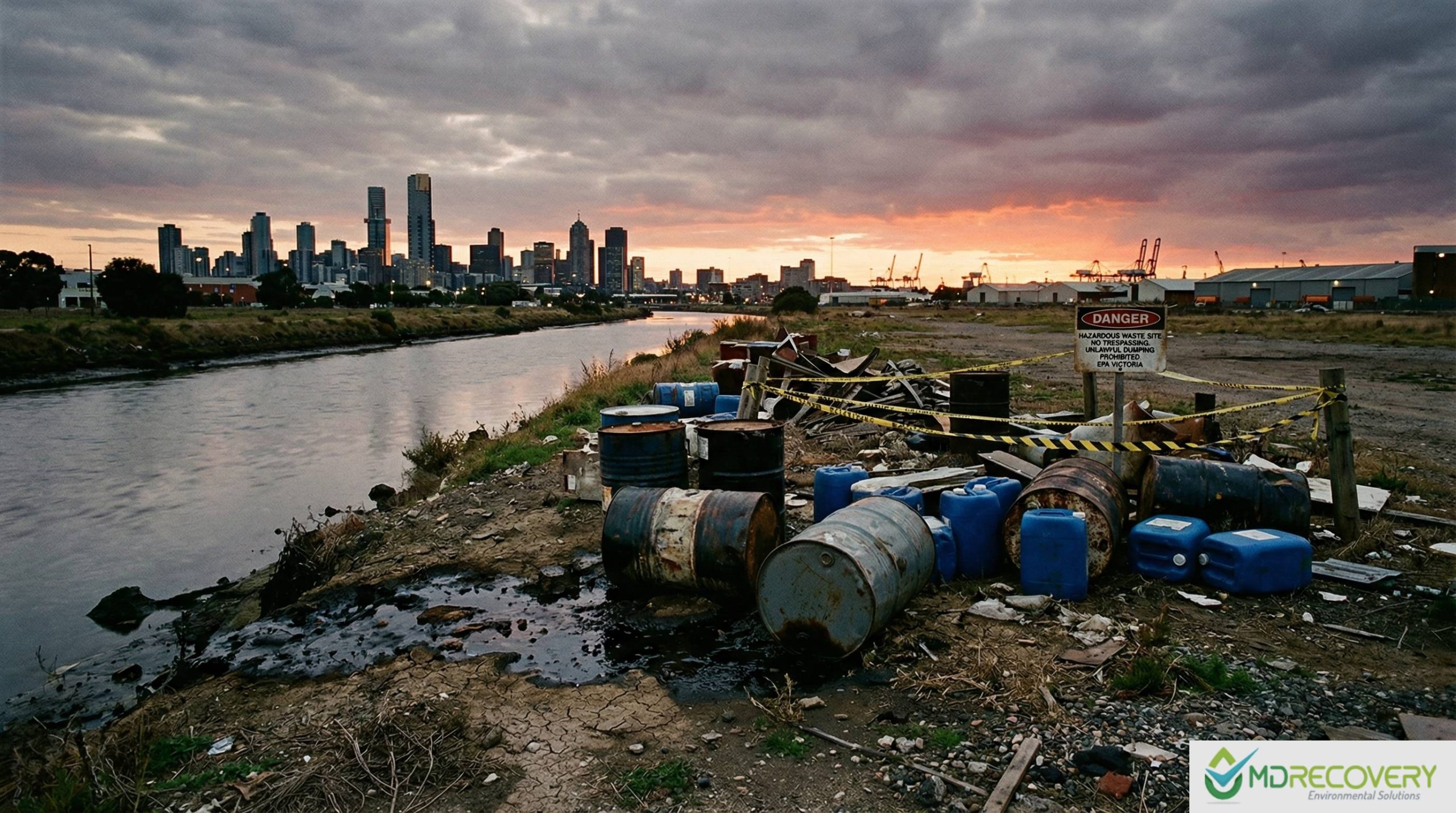
Under Victorian law, it is an offence to dump, abandon, or bury any kind of waste at a place not authorised to receive it. This includes private land, roadsides, vacant lots, and unlicensed facilities — not just obvious public spaces. The law does not make exceptions for convenience or cost.
Hazardous waste is held to an even higher standard. Materials such as solvents, acids, caustics, paints, oils, pesticides, and lab chemicals are classified as “reportable priority waste” under the Environment Protection Act 2017, meaning they require specific handling, transport documentation, and disposal through EPA-licensed facilities.
If your business generates any of these materials — whether you are a manufacturer, dry cleaner, electroplater, school laboratory, or medical practice — you have legal obligations that cannot be ignored. You can read more about the types of hazardous waste that fall under regulation in our guide to what the four types of hazardous waste are.
The EPA’s Enforcement Powers
Victoria’s Environment Protection Authority (EPA) takes illegal dumping seriously, particularly at a commercial and industrial scale. The EPA uses a wide range of tools to investigate and prosecute waste crimes, including data analytics, drones, ground-penetrating radar, surveillance, site inspections, and inter-agency law enforcement partnerships.
Critically, the EPA does not just target the person who physically dumps the waste. The chain of responsibility extends to waste generators, transporters, and receivers. If your business hires an unlicensed contractor to remove hazardous materials and they dump it illegally, your business can still face consequences.
The EPA has the power to issue a range of enforcement responses, including:
Infringement notices (on-the-spot fines): These can be issued without going to court and represent the fastest enforcement pathway for clear breaches.
Remedial notices and clean-up orders: Your business can be directed to clean up illegally dumped waste at your own expense, even if you did not physically dump it yourself. If you are a landlord whose tenant has abandoned hazardous waste on your property, you may inherit the clean-up liability.
Court-imposed penalties: Matters that proceed to court carry significantly higher financial penalties. In one real Victorian case, a director of a demolition company was fined $10,000 with conviction — plus an additional $5,000 in costs — after pleading guilty to charges including depositing waste without a licence and contravening a clean-up notice.
Licence suspension or revocation: Businesses operating under EPA permissions can have those permissions suspended or revoked for non-compliance, which can be operationally devastating.
Criminal prosecution: In serious cases involving large-scale or deliberate illegal disposal, criminal charges can result in prosecution and a permanent criminal record.
The Hidden Cost: Contaminated Land Liability
Beyond direct penalties, one of the most financially damaging consequences of illegal hazardous waste dumping is contaminated land liability. If dumped waste contaminates soil or groundwater, the duty to manage contaminated land under Victorian law can apply — even to parties who did not cause the contamination in the first place.
Remediation costs for contaminated land can run into hundreds of thousands of dollars. For a small or medium-sized business, this liability can be existential.
Ignorance Is Not a Defence
A common misconception is that a business can avoid liability by claiming it did not know the waste was hazardous or that it delegated disposal to a third party. Victoria’s General Environmental Duty requires every person and organisation to take proactive steps to eliminate or reduce the risk of harm to human health and the environment. This is not a passive obligation — it requires active due diligence.
If you are not sure how to store or prepare your hazardous waste before it is collected, our step-by-step guide on how to safely store and prepare hazardous waste is a helpful starting point.
The Responsible Path Forward
The cost of legal hazardous waste disposal is a fraction of the cost of fines, litigation, clean-up orders, and reputational damage. Working with a licensed and experienced hazardous waste disposal provider is the simplest way to protect your business.
At MD Recovery, we provide fully compliant chemical waste collection and disposal services across Melbourne and regional Victoria, with over 25 years of experience handling everything from solvents and acids to photographic chemicals and lab waste. Our scheduled collection services make compliance straightforward and stress-free.
If you are unsure whether your current waste management arrangements meet your legal obligations, contact our team today for a no-obligation conversation.